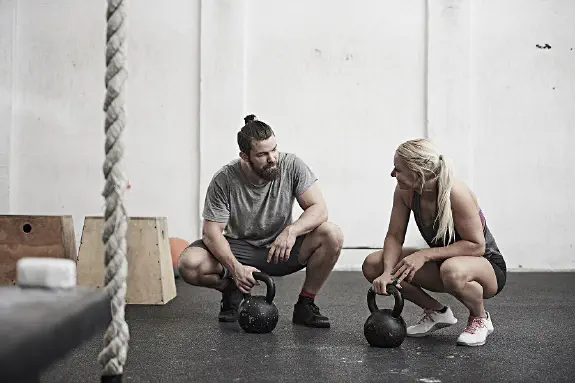
Kettlebells are compact, practical and surprisingly versatile. A single kettlebell lets you train your legs, glutes, back, shoulders and core, and a full workout can fit into a small corner of your living room or balcony. That makes them ideal for anyone who prefers to train at home, especially on hot summer days when the gym is the last place you want to be. The key is to learn the basics properly before adding weight or speed.
Choosing Your First Kettlebell
The right starting weight depends on your strength, experience and the exercises you plan to do. As a general rule, it is better to start lighter and focus on technique.
- Choose a weight you can control. You should be able to perform each movement smoothly, with good form, for the full set.
- Check the handle. It should feel comfortable and smooth in your hands, without sharp seams.
- Consider two weights. Many people use a lighter bell for overhead and single arm work and a heavier one for deadlifts and swings.
You can find different sizes in our kettlebells category, from a light 4kg kettlebell upwards.
Three Foundation Movements
Practise these slowly, ideally in front of a mirror, before you put them together in a workout.
1. Kettlebell Deadlift
Stand with your feet hip width apart and the kettlebell between your feet. Push your hips back, keep your back flat and chest proud, and grip the handle. Stand up by driving through your heels and squeezing your glutes, then lower the bell with control. This teaches the hip hinge, which is the basis of the swing.
2. Goblet Squat
Hold the kettlebell close to your chest by the sides of the handle. Keep your elbows in, sit down between your heels as far as is comfortable, then stand back up. Keep your knees in line with your toes and your heels on the floor.
3. Kettlebell Swing
Once your deadlift feels solid, try the swing. Hike the bell back between your legs like a footballer, then snap your hips forward to send it to about chest height. Your arms guide the bell, but the power comes from your hips. Let it fall back between your legs and repeat. Stop if your lower back starts to work harder than your glutes.
A Simple Beginner Workout
Do this two or three times a week, with at least a day of rest in between. Rest for about a minute between sets.
- Warm up for five minutes: marching, arm circles, bodyweight squats.
- Kettlebell deadlift: 3 sets of 10.
- Goblet squat: 3 sets of 8 to 10.
- Single arm row (one hand supported on a bench or chair): 3 sets of 8 per side.
- Kettlebell swing: 3 sets of 10 to 15, once your hinge is confident.
- Finish with a few minutes of gentle stretching.
As you improve, increase repetitions first, then sets, and only then the weight.
Safety First
- Train on a stable, non slip surface with enough space around you.
- Keep a firm grip and dry hands. Stop when your grip or form starts to fail.
- Never twist your back while lifting, and keep your spine neutral.
- Make sure children and pets are well out of the way.
- In hot weather, train in the cooler hours of the day and drink plenty of water.
If you have back, shoulder or joint problems, are new to exercise or have a medical condition, speak to your doctor before starting. A qualified personal trainer can check your technique, which is especially valuable for the swing.
Learn the basics, be patient with your progress and kettlebells can become one of the most efficient tools in your home training.